Let’s be honest—most advertisers treat branded search like a utility bill. You just pay it and move on. No one questions it. No one optimizes it. Because hey, it’s your own brand name. You’re supposed to win that auction.
But here’s the problem: you’re probably overpaying.
We wanted to challenge the lazy assumption that “branded = cheap = ignore.” So we built a simple framework to quantify the actual value of each branded click, and figure out what we should be paying to maximize ROI.
Here’s how we did it.
Step 1: Export the Search Terms Report
Don’t trust campaign-level data. Don’t trust keyword-level data. Go straight to the search terms report. This is the closest thing to the auction itself, and it’s the only way to slice performance at the level that matters.
We exported everything and dumped it into a Google Sheet. Nothing fancy—just raw data.
Step 2: Filter to Branded Queries
We filtered the search term column by brand name.
That gave us a clean list of branded queries.
Pro tip: Don’t use campaign names to identify branded traffic. Use the actual search terms. You’d be shocked how many “brand” campaigns are full of generic junk.
Step 3: Add a Rounded CPC Column
We wanted to group performance by CPC levels. So we created a new column using:
pgsql
Copy code
=ROUND(F2)
This rounded the actual CPCs to the nearest whole dollar. You could get fancier with buckets (like $0.25 or $0.10 increments), but whole dollars were enough to spot trends.
This let us answer:
What happens to conversion rate and CPA as we pay more per click?
Step 4: Build a Pivot Table
From there, we built a pivot table showing:
- Total clicks
- Conversions
- Cost
- CPA
...all segmented by rounded CPC values.
Now we had a clear distribution of performance by bid level. And surprise: CPCs were all over the place. Some auctions were incredibly efficient. Others were complete garbage.
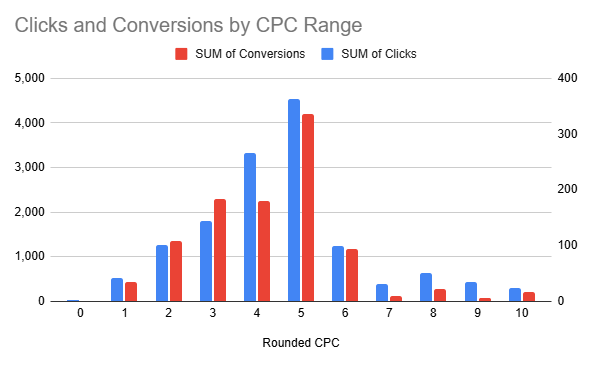
This is why averages lie.
Step 5: Draw the Line
Looking at the pivot, we started to see the drop-off points.
There was a tight range—let’s say $1 to $2.50—where branded clicks were converting like crazy. But once CPCs crossed that threshold, returns fell off a cliff. Same intent, worse efficiency.
So what do you do?
- Cap your CPCs in that “goldilocks” range
- Add bid rules to push back when Google gets greedy
- And for the love of god, stop treating branded like a fixed cost
The Bigger Lesson
You don’t need AI to do this.
You don’t need a third-party tool or some magical bid algorithm. All it takes is a spreadsheet, a pivot table, and a willingness to question the defaults.
The best media buyers aren’t optimizing campaigns—they’re reverse engineering business math. And that starts by asking,
What’s the right price for a branded click?
Now you have a way to answer it.